

AI “OS Agents” Could Take Over Devices — Why That Matters for Healthcare IT
Original source:
“Study warns of security risks as ‘OS agents’ gain control of computers and phones”
by Michael Nuñez, VentureBeat (Aug 11, 2025).
autonomously click, type, and navigate — highlights exciting capabilities and serious security implications.
Below is a CHUG‑focused summary of the key points, with figures from the paper to orient readers.
What Are “OS Agents”?
OS Agents combine language models with visual perception so they can operate apps and websites the way a user would —
by reading screens and manipulating GUIs. They can perform multi‑step tasks such as opening applications, entering data,
retrieving information, and chaining actions across tools.
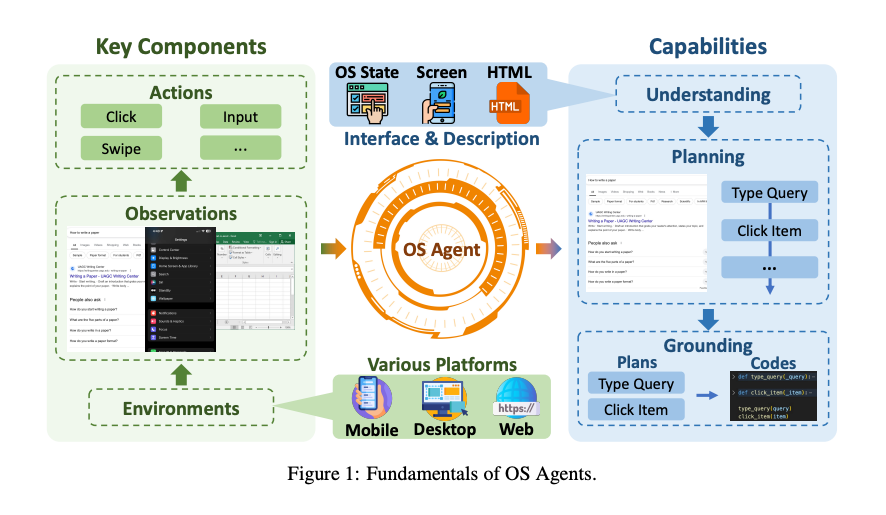
descriptions (OS state, screen, HTML) and core capabilities (understanding, planning, grounding).
How They’re Built: Foundation Models & Training
Under the hood, OS Agents rely on multimodal models (vision + language), pre‑training on public and synthetic data,
followed by supervised finetuning and reinforcement learning. Grounding steps translate abstract instructions into
executable actions; navigation steps turn plans into GUI interactions.
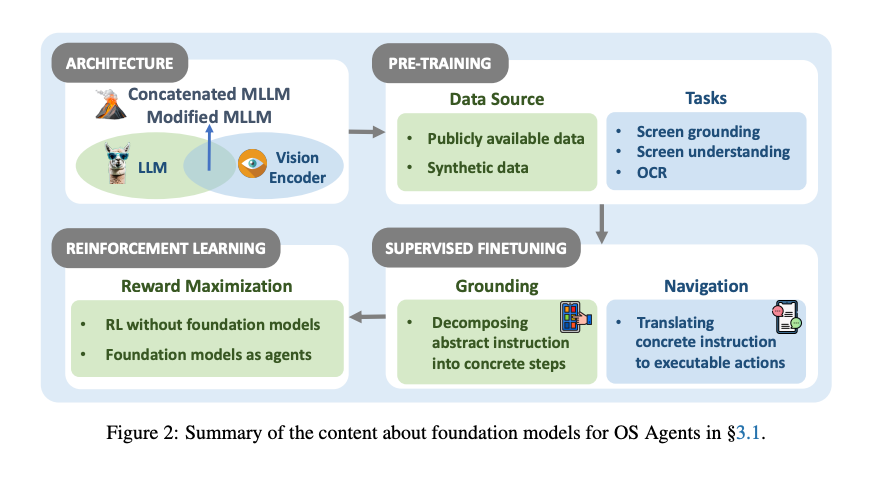
pre‑training data sources, supervised finetuning (grounding & navigation), and reinforcement learning for reward maximization.
Agent Frameworks: Perception, (Optional) Planning, Memory, and Action
Mature OS Agents organize around four blocks: Perception (screen & text understanding),
Planning (global or iterative), Memory (internal/external/specific with optimization),
and Action (input, navigation, and extended operations).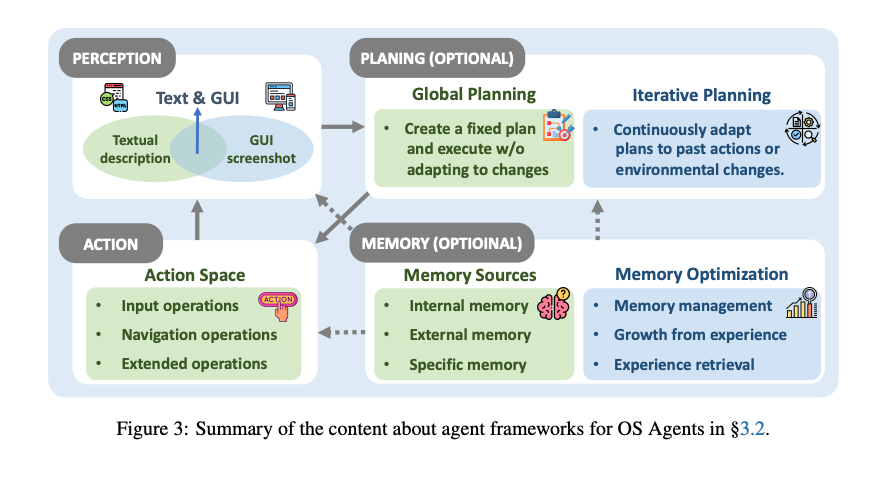
that executes operations in the UI.
Why Security Teams Should Care
- Indirect prompt injection: Malicious web content can steer an agent to perform unintended actions.
- Environmental attacks: UI elements, images, or hidden text can leak data or trigger unsafe behavior.
- Expanded blast radius: Agents with wide permissions (email, EHR, shared drives) increase the stakes of compromise.
- Auditability gaps: Complex, multi‑step autonomy makes it harder to trace “why” an action occurred.
Practical Takeaways for CHUG Users
- Scope agent permissions tightly; prefer least‑privilege and per‑task tokens.
- Gate external content (sanitization, allow‑lists) and isolate high‑risk browsing contexts.
- Log everything the agent sees and does; enable replay to support incident response.
- Use evaluation sandboxes before granting access to production apps or PHI.
- Plan for human‑in‑the‑loop review on sensitive or irreversible actions.
Attribution & Sharing Note
This post summarizes and comments on reporting by Michael Nuñez for VentureBeat.
Please read and support the original article here:
VentureBeat — Study warns of security risks as ‘OS agents’ gain control of computers and phones.
VentureBeat’s article does not include a permissive reuse license; this summary is provided under fair‑use principles
with clear attribution and linkage. For redistribution beyond quotation and linking, consult VentureBeat’s site terms.